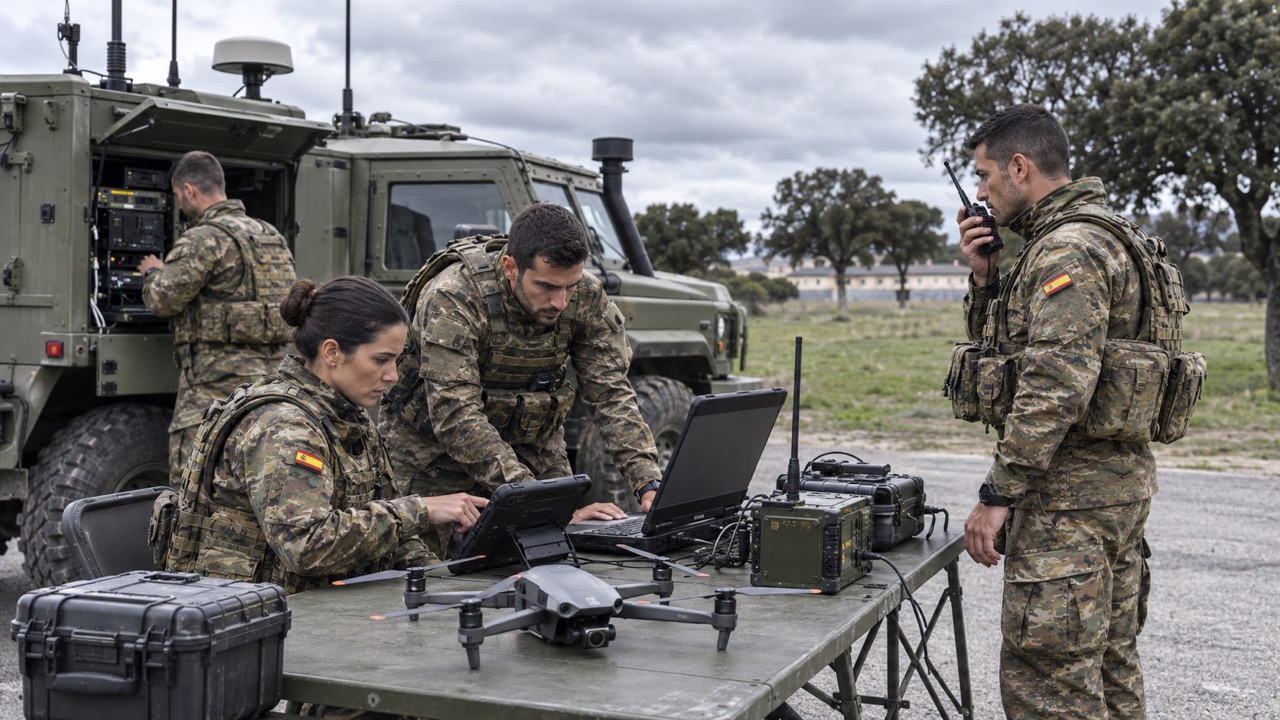
About 260 personnel will take part in Exercise Steadfast Dagger 26 in Norway, where the Spanish headquarters will be assessed on its ability to direct multinational operations. The unit will command the Allied Reaction Force (ARF) land component from July 2027 through June 2028.
Beginning November 24, the Castillejos Division Headquarters, based in Huesca, will undergo one of the most significant tests in its NATO preparation process. Exercise Steadfast Dagger 26, to be held at the Joint Warfare Centre in Stavanger, Norway, will assess its capability to plan and command multinational land operations before it assumes command of the Allied Reaction Force (ARF) land component in July 2027.
The unit, commanded by Maj. Gen. Luis Francisco Cepeda Lucas, has completed a two-year operational transformation program encompassing training exercises, command-and-control procedures, the integration of allied personnel, and adaptation of its communications systems. According to information provided during a presentation held Monday, November 16, about 260 military personnel will participate in the certification phase in Norway.
The objective is to pass the combat-readiness assessment process known as CREVAL (Combat Readiness Evaluation), which will determine whether the headquarters meets the requirements to serve as a Land Component Command (LCC). This role entails planning and directing the land operations of a multinational force, coordinating units from different nations, and synchronizing their activities with air, maritime, and special operations components.
The certification is the final major examination in Castillejos’ preparation process before it assumes the operational commitment for the period from July 1, 2027, through June 30, 2028.
Interoperability and multinational command at the center of the assessment
Steadfast Dagger 26 will be a computer-assisted command-post exercise (CPX/CAX) focused on assessing planning procedures, decision-making, and operational coordination in a simulated scenario. This type of training makes it possible to evaluate the performance of headquarters staffs and their command systems without having to replicate in the field all the movements of units that would take part in an actual operation.
Castillejos Division has spent months integrating procedures and digital tools that will enable it to operate within a multinational structure. Preparatory activities included a planning exercise held in Huesca from June 9 to 24, during which the Land Operations Planning Group (LOPG) developed the operations order, or OPORD, planned for certification in Norway.
The process has also included the integration of allied officers into the command structure. They include Turkish Col. Bahri Yildiz, designated deputy commander of the land component, who took part in the planning activities conducted in Huesca.
More recently, from October 20 to 22, the headquarters hosted preparation sessions in which the concept of operations (CONOPS) was reviewed and the maneuver was rehearsed through a Rehearsal of Concept Drill (RoC Drill). The activity enabled participants to analyze the planned phases, identify potential coordination issues, and refine procedures for subordinate units.
During the same sessions, personnel worked with SitaWare, a command-and-control system that enables the management of operational information, tracking of operations, and coordination among headquarters elements. The interoperability of these tools is a requirement for integrating the Spanish command into NATO’s multinational structure.
A strategic reserve for rapid-response operations
NATO activated the Allied Reaction Force in July 2024 as part of the new NATO Force Model approved following the reorganization of the Alliance’s collective-defense capabilities. Its creation responds to the need for a high-readiness multinational force capable of deploying rapidly and operating across different operational scenarios.
The ARF integrates land, air, maritime, special operations, logistics, and other capabilities, including cyberspace and space. It is designed as a flexible strategic reserve that can be activated by the Supreme Allied Commander Europe (SACEUR) to reinforce deterrence, respond to crises, or support collective-defense operations.
Castillejos Division will specifically command its land component within a broader joint structure. This distinction is relevant because overall command of the ARF rests with the NATO chain of command, not with the Spanish headquarters.
One characteristic of the force is its ability to respond with limited warning. During the exercise presentation, Gen. Cepeda said it must be ready to deploy in less than 10 days, a requirement that affects both unit readiness and planning and logistics-support procedures.
Spain’s commitment also includes the participation of the Legion Brigade as the brigade assigned to the ARF. Its integration was addressed during a multinational seminar held in Huesca on October 14 and 15, attended by representatives of the countries contributing forces and capabilities to the force.
Operational commitment will extend through June 2028
The schedule established by the Spanish Army includes two distinct phases. The first, known as Stand Up, began on July 1, 2026, and will run through June 30, 2027. During this period, the command will prepare, complete its assessments, and consolidate the procedures required to achieve the necessary operational readiness.
The second phase, Stand By, will begin on July 1, 2027, and end on June 30, 2028. Throughout those 12 months, Castillejos Division Headquarters must remain ready to assume, with limited warning, command of multinational land operations that the Alliance may order.
The preparation program will continue in 2027 with additional training and coordination activities. These include certification of the brigade assigned to the ARF, for which the Minerva simulator at the San Gregorio National Training Center in Zaragoza is expected to be used, along with other exercises and mission rehearsals.
Spain’s participation in the Allied Reaction Force has precedents in other components. Spain has held leadership responsibilities in the ARF’s air, maritime, and special operations commands since the force was activated in 2024. Castillejos’ designation extends that contribution to the land component and requires a headquarters capable of integrating into NATO planning and operational command procedures.
The Stavanger assessment will verify the results of work conducted since 2025 and determine whether the Spanish command has reached the required operational standards. Passing it will clear the way for Castillejos Division to complete preparations for its commitment and assume its assigned responsibilities in July 2027.