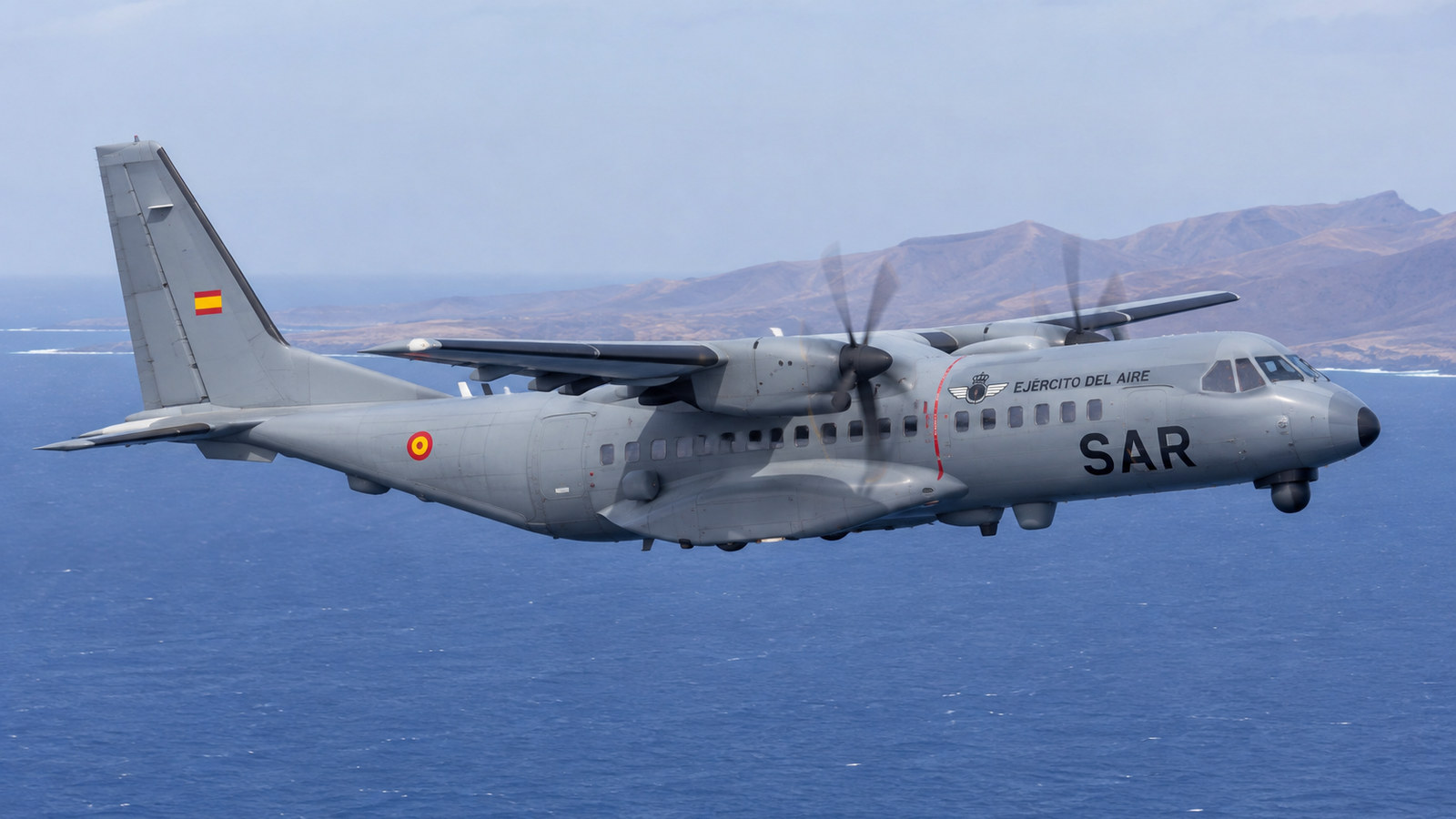
The Spanish Air and Space Force has assigned its second C295 configured for search-and-rescue missions to Wing 46, based at Gando Air Base on Gran Canaria. The aircraft will operate from the Canary Islands on maritime surveillance, intelligence, reconnaissance, and rescue missions in the Atlantic.
The aircraft’s arrival coincides with an increase in arrivals along the Atlantic route, according to preliminary figures attributed to the Information Unit of the Canary Islands Police General Corps. Between November 1 and 16, the archipelago recorded 11,657 arrivals in 118 vessels, compared with 1,271 people recorded during the same period in 2025.
Capt. Caridad Martínez, a Wing 46 pilot, said one of the aircraft’s roles will be to support the location of drifting vessels in order to facilitate the response of rescue teams. The C295 can cover large maritime areas and, after detecting an objective, track it and drop life rafts if necessary while other assets are mobilized.
MPA/SAR Program and Replacement of the CN-235
The aircraft is part of the MPA/SAR program, contracted by Spain’s Ministry of Defense from Airbus in December 2023 for €1.695 billion. The plan calls for the acquisition of 16 C295s: eight in the SAR configuration for search-and-rescue and maritime-surveillance missions, and another eight in the MPA maritime-patrol configuration.
The eight C295 SAR aircraft will progressively replace the CN-235 Vigma aircraft, which have been in service since 2008. These aircraft are intended for maritime and land surveillance, counter-smuggling, counternarcotics, and irregular-migration missions, as well as national and international search-and-rescue operations.
The first aircraft was received in June at Airbus facilities in San Pablo, Seville, before its transfer to Gran Canaria. With the arrival of the second aircraft, Wing 46 is expanding the fleet assigned to operations in the Canary Islands.
The MPA component of the program is intended to restore the Spanish Air and Space Force’s maritime-patrol and antisubmarine-warfare capabilities, which were progressively reduced after the retirement of the P-3 Orion.
Sensors for Surveillance and Rescue
The C295 SAR is equipped with a radar installed beneath the fuselage to detect and locate targets on the sea surface. It also incorporates an electro-optical/infrared turret beneath the nose, capable of providing real-time imagery by day and night and tracking vessels from altitude and at range.
The configuration also includes an Enhanced Vision System, based on external cameras and sensors, to facilitate operations in low-visibility conditions such as darkness, fog, rain, or smoke. Its surveillance tasks include detecting illicit activity, vessels that are difficult to identify, discrepancies between declared information and the cargo being carried, drifting boats, and cayucos en route to the Canary Islands.
The aircraft integrates a Fully Integrated Tactical System that brings together sensor data at mission consoles. One or two specialists can analyze that information and transmit it to the ground support center, which maintains oversight of the operation and can share the data with other deployed assets.
According to Capt. Martínez, the C295 will take over the CN-235’s maritime surveillance, intelligence, reconnaissance, and search-and-rescue roles, both in Spain and in international operations. The pilot highlighted the engine power and the greater amount of information integrated on cockpit displays among the differences from the previous aircraft.
What do you think about this report? We invite you to leave a comment and share the article on your social media channels.
Comments must comply with ClaveDefensa’s participation rules. Failure to do so may result in removal.