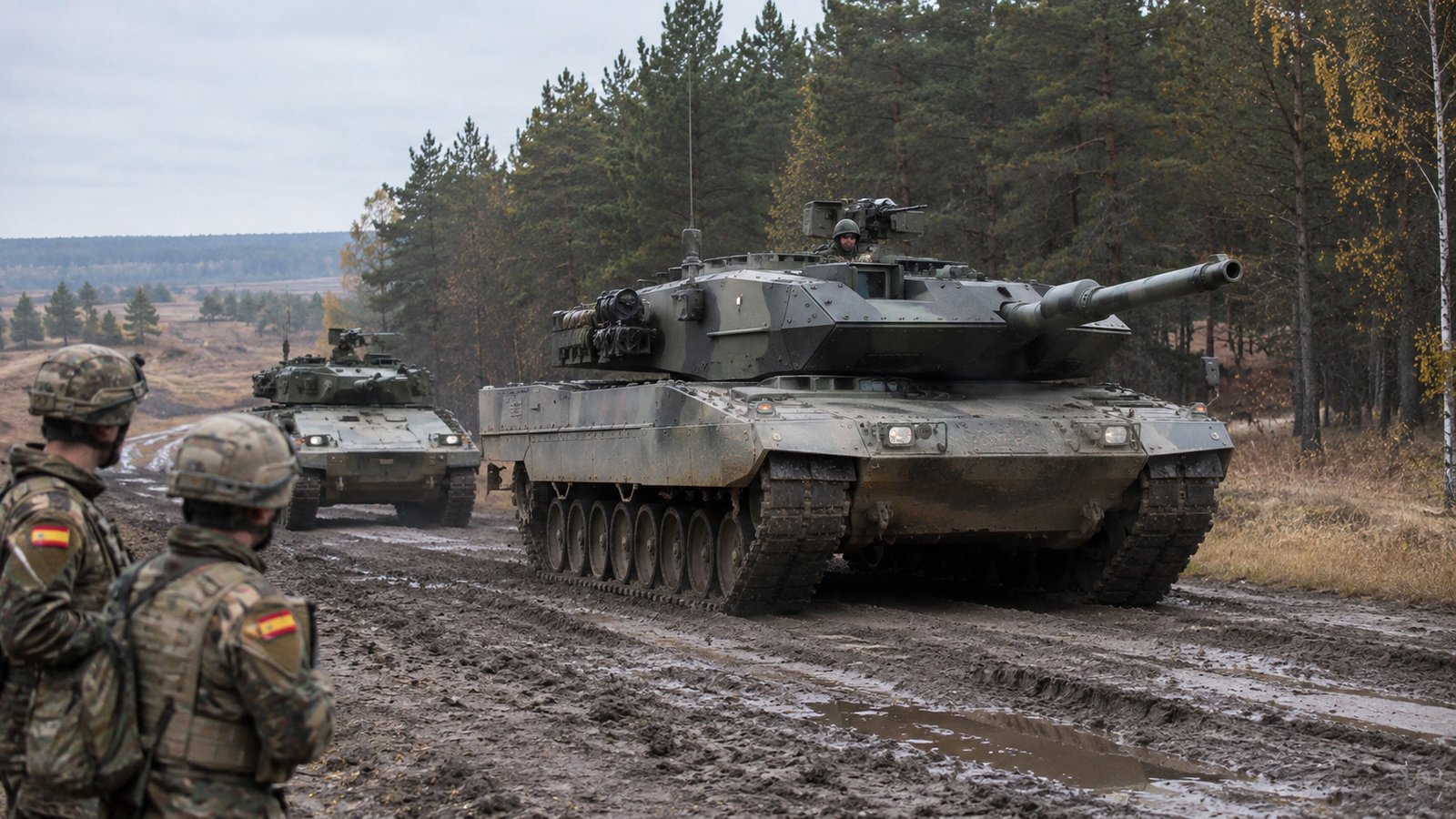
The Spanish Army has participated in Exercise Resolute Reforger in Latvia, a training activity focused on the deployment, sustainment and coordination of heavy forces integrated into NATO’s multinational battlegroup in the Baltic country. The activity included combined road and rail movements of Leopard 2E main battle tanks and Pizarro infantry fighting vehicles.
The movement of armored assets enabled participating forces to rehearse procedures for moving heavy units and coordinating the elements involved in the deployment. The exercise also included live-fire training, training in urbanized areas, the preparation of defensive positions, and activities involving unmanned aerial systems.
Unit Planning and Sustainment
Participating units conducted planning and coordination exercises intended to improve command-and-control procedures and shared situational awareness. According to the Spanish Defense Staff, the activity helped refine joint procedures for deployment, logistical sustainment and the employment of equipment during operations.
Spain maintains Leopard 2E tanks, Pizarro vehicles, M109 self-propelled howitzers, M-113 tracked armored personnel carriers, heavy mortars and combat engineer vehicles in Latvia. The contingent also includes an engineer unit, logistical support elements, Spike anti-tank missiles, a Joint Terminal Attack Controller team and a Raven unmanned aerial system.
Among the deployed assets is an air defense unit equipped with the NASAMS system. According to the information provided, this capability is part of the protection of Latvian airspace and the reinforcement of Allied defense on the eastern flank.
Military Mobility on the Eastern Flank
The exercise was conducted within the framework of NATO’s multinational brigade in Latvia, led by Canada. The mobility of tanks, armored vehicles, ammunition and equipment is one of the issues addressed in this type of training, as it requires suitable infrastructure and logistical coordination among participating units.
The European Union and NATO are advancing measures to facilitate military movements between countries, including adapting roads, bridges, ports and rail lines for the transit of heavy vehicles. These initiatives also provide for simplifying administrative and border procedures associated with the movement of forces and materiel.
What do you think about this information? We invite you to leave a comment and share this article on your social media channels.
Comments must comply with ClaveDefensa’s participation rules. Failure to do so may result in expulsion.