The Spanish Navy will add two new unmanned surface vehicles developed by Spanish companies Seadrone and Utek under contracts processed by the Rota Naval Intendancy, with a combined value of approximately €2.4 million. The platforms will support experimentation with systems intended for different missions, including the development of procedures for employing unmanned vehicles.
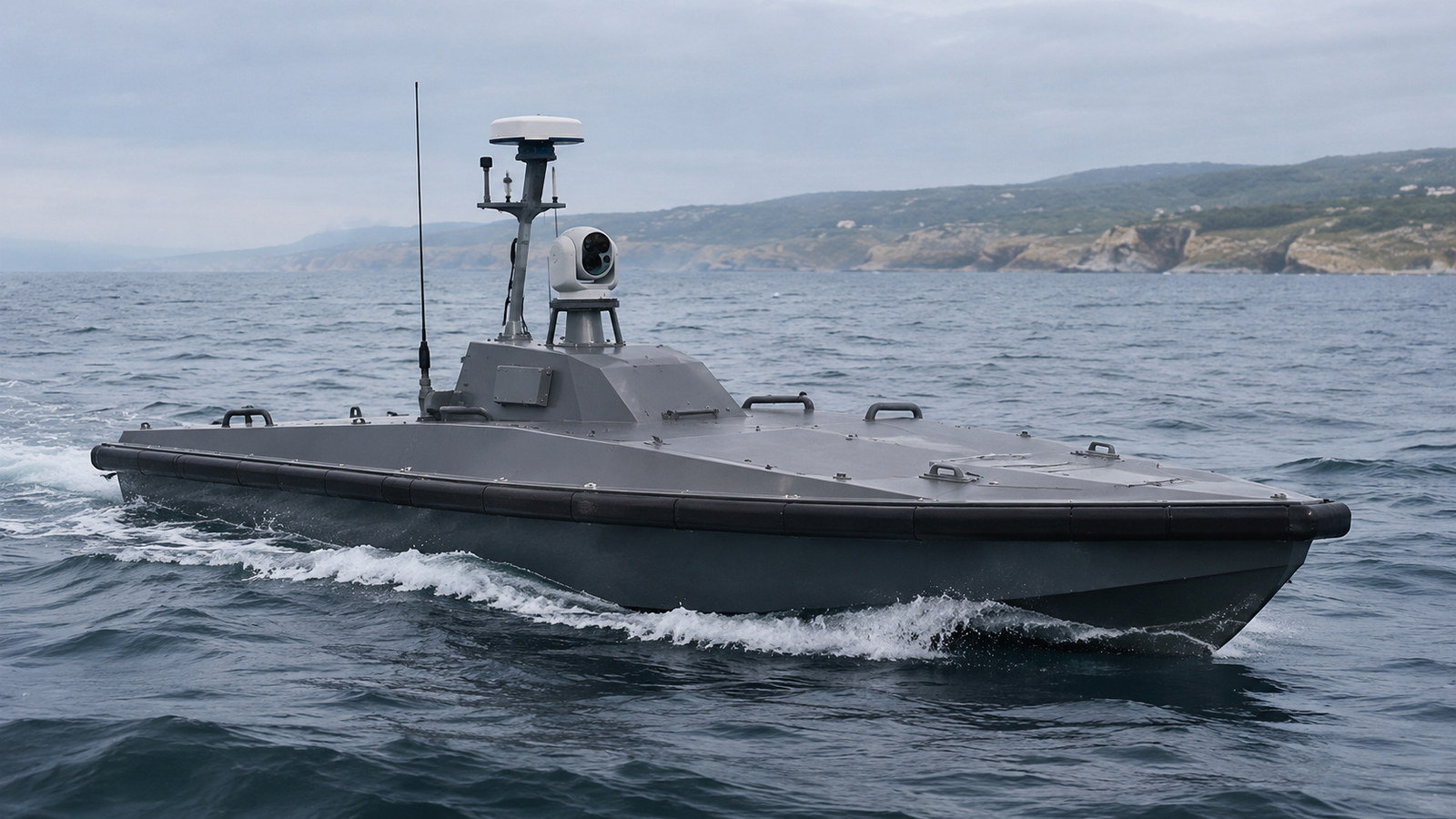
One contract covers the acquisition of a second Sead 23 vehicle, built by Seadrone and Zelenza, for €1.17 million. The unit will be assigned to the Spanish Navy’s Center for Experimentation and Unmanned Vehicles (Ceventa), at Rota Naval Base, and will be intended to strengthen experimentation in anti-surface warfare and serve as a littoral patrol platform against surface threats.
A Second Sead 23 for Ceventa
The Sead 23 is 7 meters long, has a 250-horsepower engine, and a maximum speed of 30 knots. It has a range of 200 nautical miles at 15 knots and can carry a payload of up to 300 kilograms.
Its equipment includes a multibeam sonar, surface-search radar, an Automatic Identification System (AIS), and electro-optical and infrared cameras. The vehicle can operate through satellite, radio-frequency, and 5G links.
Ceventa has operated a Sead 23 since December 2025. The first unit was received following an evaluation period of approximately two years, during which it participated in the Repmus, Baltops, and Dynamic Messenger exercises.
A Modular Platform Supplied by Utek
The second contract, valued at €1.23 million, was awarded to Utek together with Narwhal Boats for the supply of a modular, multimission unmanned surface vehicle. The available information does not definitively identify the selected model, although the Kunai and Kaluga platforms appear to be possible candidates based on the characteristics of the procurement and the company’s product range.
Unlike the Sead 23, which was designed specifically for anti-surface warfare missions, Utek’s system is envisaged as a platform configurable with different payloads and equipment. Utek has previously collaborated with the Spanish Navy in the development and experimentation of autonomous platforms, including the Kunai, which was supplied to Ceventa for evaluation.
Reporting to the Fleet and based at Rota, Ceventa conducts experimentation and integration activities involving unmanned technologies and serves as an interface with industry to identify operational requirements and assess new solutions. The addition of the two vehicles will enable experimentation with platforms of differing characteristics, from systems intended for combat missions to modular craft capable of performing multiple roles.
What do you think about this information? We invite you to leave a comment and share the article on your social-media channels.
Comments must comply with ClaveDefensa’s participation rules. Failure to do so may result in expulsion.