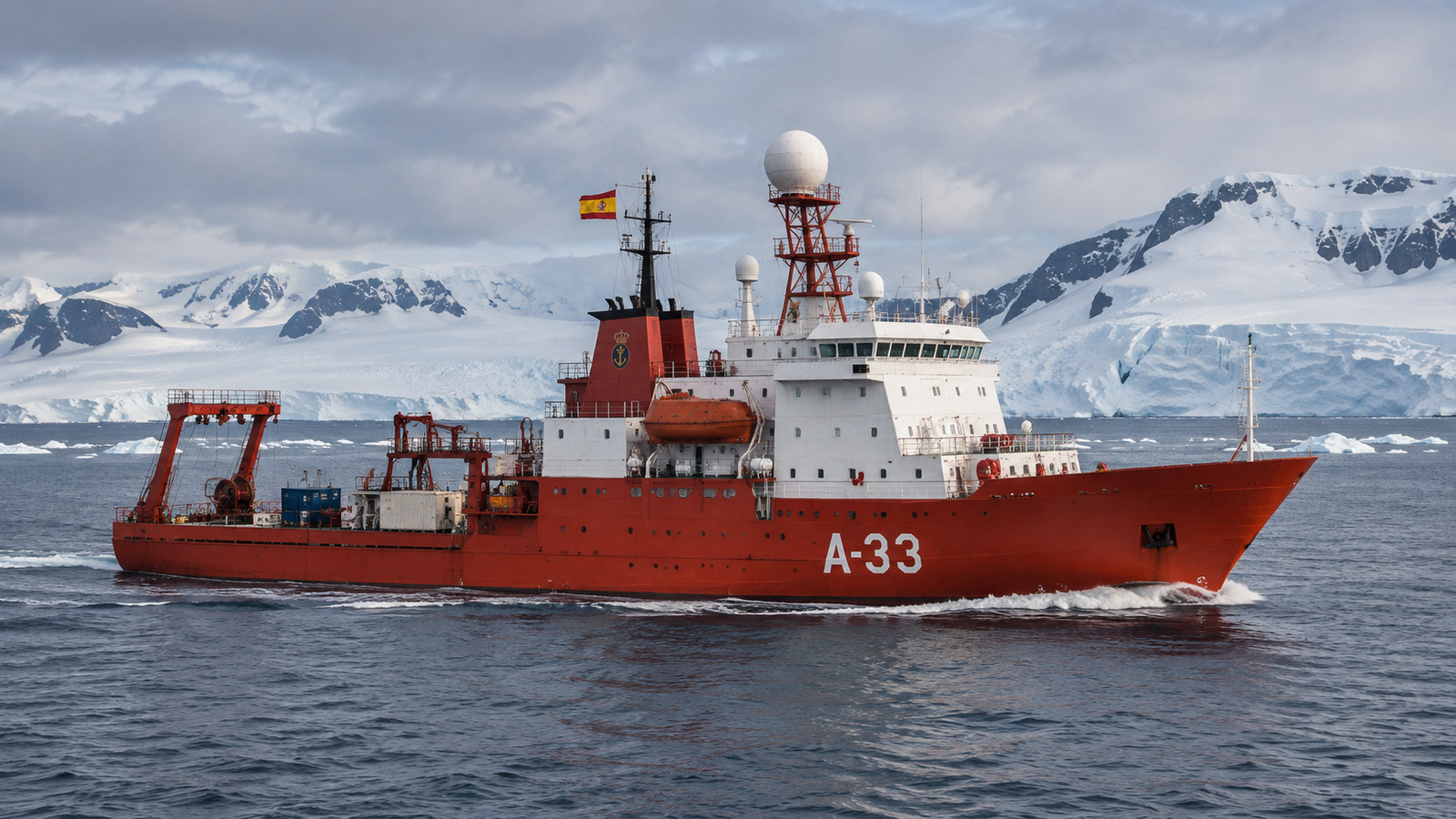
The oceanographic research vessel Hespérides has departed the Cartagena Naval Arsenal to take part in the 2026–2027 Spanish Antarctic Campaign, a deployment of more than four months that will combine support for Spain’s Antarctic bases with three scientific projects. The vessel is scheduled to return to Cartagena on April 24, 2027, following a final port call in Mindelo, Cape Verde.
The first leg of the voyage will take the ship to Rio de Janeiro and then to the Strait of Magellan. The vessel will call at Punta Arenas, Chile, where researchers assigned to the first scientific project and technical personnel from the Marine Technology Unit of Spain’s National Research Council (CSIC) will embark.
From Punta Arenas, Hespérides will sail to Livingston and Deception islands in the South Shetland Islands archipelago. There, it will begin logistical support tasks for Spain’s Juan Carlos I and Gabriel de Castilla Antarctic bases, which are expected to have been opened beforehand by the oceanographic vessel Odón de Buen. Once those operations are complete, the first of the scheduled research cruises will begin.
Support for bases and scientific projects
During its time in polar waters, Hespérides will participate in three research projects in the seas near the Antarctic Peninsula and the South Shetland Islands. Scientific activity will be conducted alongside the transport of personnel and resupply of materials for the Spanish installations.
The main logistical hubs for the operations will be the ports of Punta Arenas and Ushuaia, Argentina. The campaign will conclude in late March 2027 with support for the closure of the Juan Carlos I and Gabriel de Castilla bases, which will remain inactive until the following austral summer.
Up to six crossings of the Hoces Sea
The itinerary includes up to six transits of the Hoces Sea, the body of water between the southern tip of the Americas and Antarctica. Hespérides is designed to operate in polar regions and withstand the navigational conditions in this area, described as one of the world’s most demanding maritime passages.
The crossings also coincide with the 2026 commemoration of the 500th anniversary of Francisco de Hoces’ expedition. According to the historical account cited for this campaign, the Spanish navigator sailed south of Tierra del Fuego in 1526 aboard the caravel San Lesmes, identifying the connection between the Atlantic and Pacific oceans between Cape Horn and the Antarctic Peninsula.
The BIO Hespérides is assigned to the Spanish Navy’s Maritime Action Force and conducts multidisciplinary research missions in coordination with the Ministry of Science, Innovation and Universities and the CSIC. The campaign also brings together various public and private institutions, while the Spanish Polar Committee coordinates the activities of participating organizations.
The continued Spanish scientific presence in Antarctica also raises the question of a future replacement for Hespérides, which has accumulated more than three decades of service. Any eventual replacement platform will need to retain the oceanographic, logistical and polar-water operating capabilities required to sustain Antarctic campaigns and support Spain’s bases.
What do you think about this report? We invite you to leave a comment and share the article on your social media channels.
Comments must comply with ClaveDefensa’s participation rules. Failure to do so may result in removal.