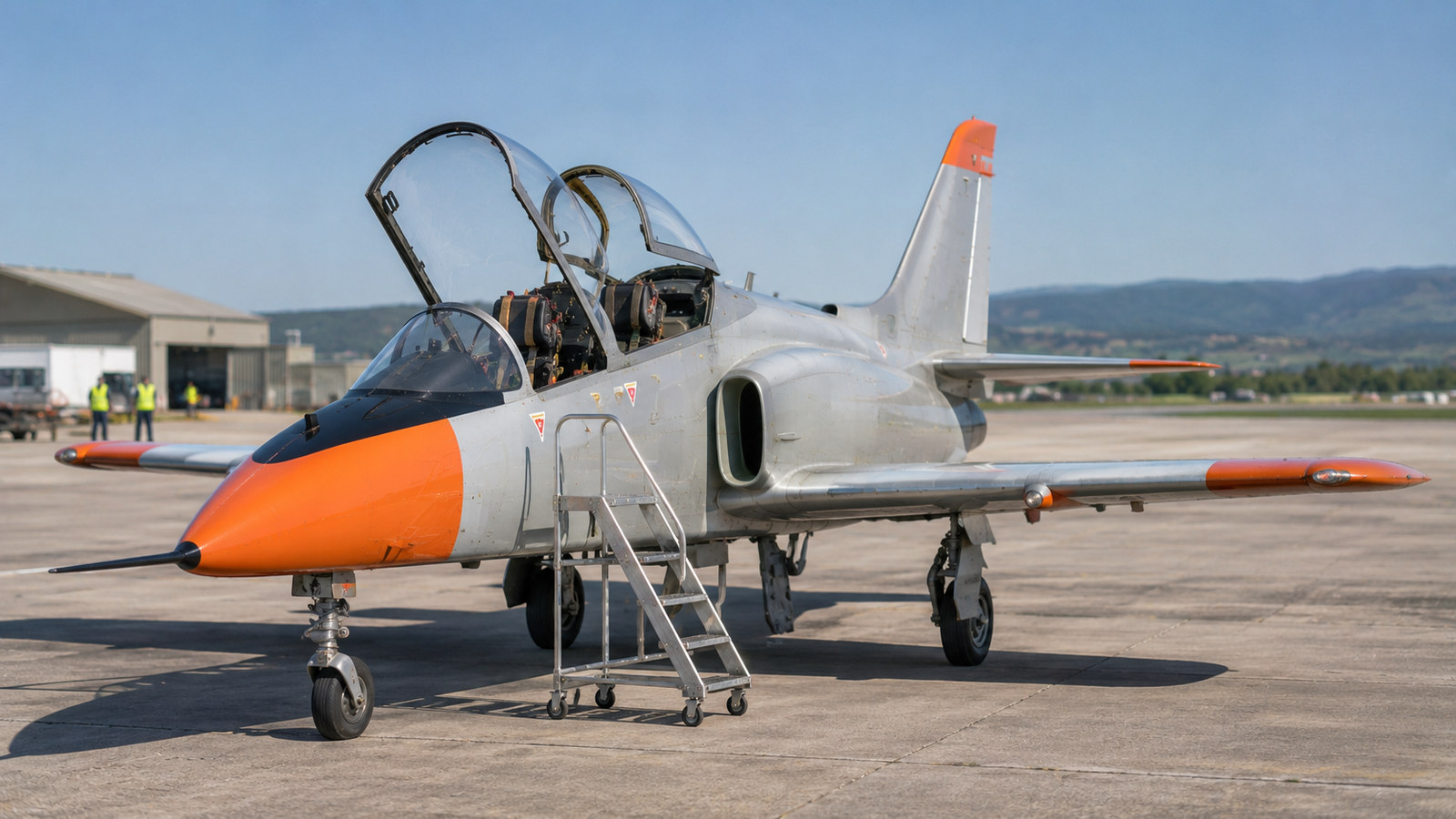
Airbus Defence and Space and the Spanish Air and Space Force have conducted high-capacity air-to-air connectivity trials between two C-101 aircraft at Albacete Air Base. The campaign enabled real-time exchange of tactical information, video and telemetry data between the two aircraft and a ground station at separations exceeding 200 nautical miles, or about 370 kilometers.
The tests were conducted under the Bacsi project, an acronym for Connected, Sustainable and Intelligent Air Base, an initiative intended to incorporate connectivity, digitalization and security technologies at Spanish Air and Space Force installations. According to information released on the trials, the two C-101s maintained continuous communications during different flight profiles, including turns and scenarios involving wide separation between the platforms.
Network continuity testing
The campaign also included deliberate network disruptions to assess the restoration of communications following degradation or a temporary loss of the link. The system re-established connectivity after these controlled interruptions, a capability that may be relevant to sustaining data exchange between aircraft and ground stations when communications are affected by incidents.
The system used is based on an IP architecture and employs domestically developed technology, according to Airbus Defence and Space. The company links the development to its experience in other military connectivity programs, including Auto’Mate, focused on autonomous control and collaborative drone flight, and Commomiss, intended for ground-based remote control of the C295 aircraft’s tactical mission system.
Bacsi project background
The trials build on previous Bacsi tests in which a C295 generated a 5G connectivity network to link helicopters and aircraft in real time. In those demonstrations, the aircraft also served as relay nodes to ground stations located beyond their direct range.
The test involving two C-101s extends that approach to a direct network between airborne platforms. The stated objective is to facilitate the transmission of large volumes of tactical information and maintain service following controlled disruptions, integrating aircraft, ground systems and control centers within a single communications architecture.
What do you think about this report? We invite you to leave a comment and share the article on your social media channels.
Comments must comply with ClaveDefensa’s participation rules. Failure to do so may result in removal.